The policy platform built for HUD entitlement grantees
Govtrak is a policy management platform to keep CDBG, HOME, ESG, and HOPWA policy current and audit-ready:
- Draft policies researched against current regulation
- Regulatory citations behind every policy
- HUD rule changes flagged with a suggested edit
- Multi-stage review and approval before anything is finalized
- Tracked changes and full version history
- Acknowledgment records tied to each version
From the team behind Supporting Peers
Policy editor — CDBG procurement
In review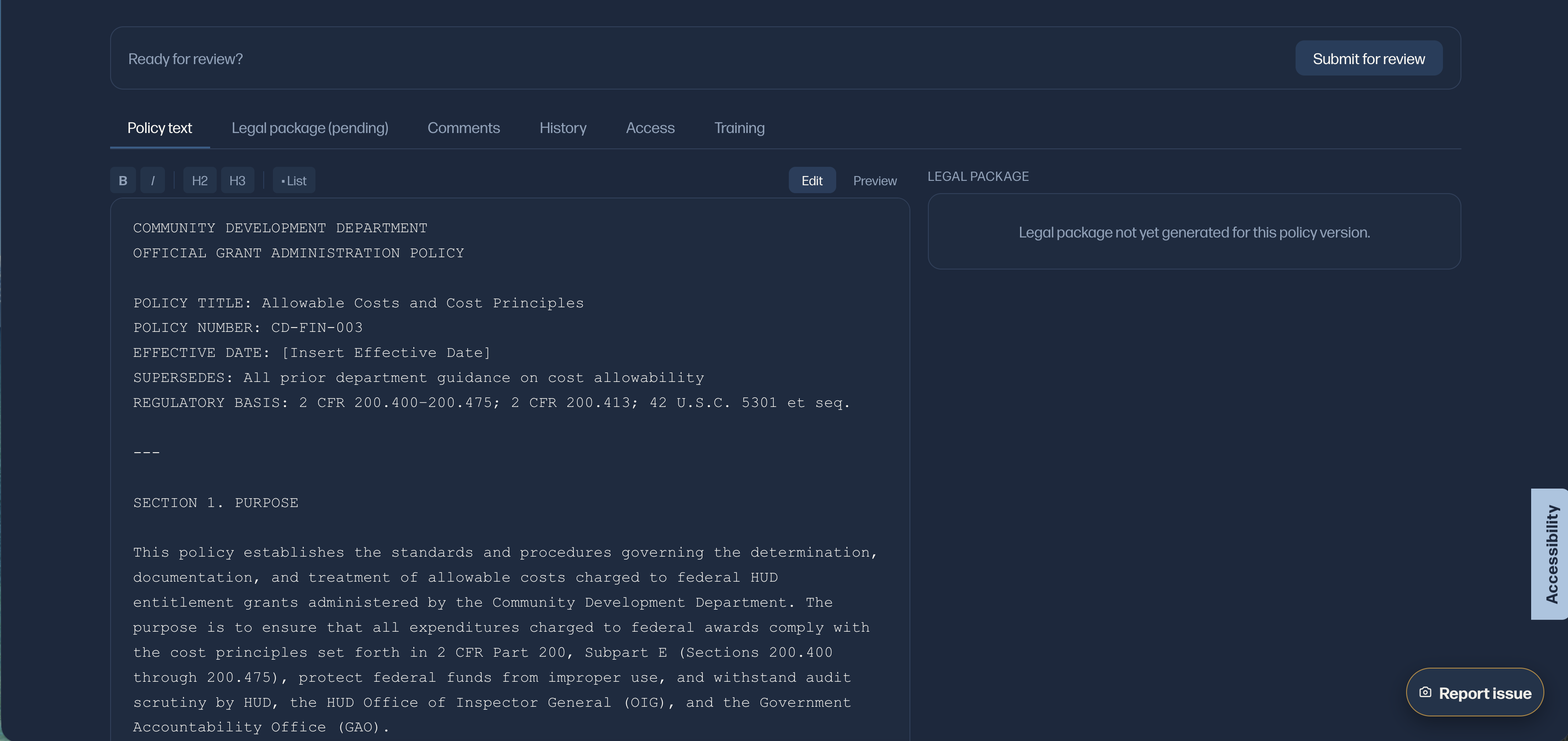
Regulatory basis
24 CFR 570.489(g) — procurement and conflict of interest
One license covers
plus every federal cross-cutting requirement
The problem
The current market is broken
Grantees repay millions
HUD monitoring and single audits regularly find grantees lacked adequate written policies and procedures — and recommend repayment of misused or unsupported funds, sometimes in the millions, from non-Federal dollars.
Scattered across binders and drives
CDBG, HOME, ESG, and HOPWA compliance policies live in disconnected documents with no acknowledgment trail — no record of who read what, or when.
Turnover erases institutional knowledge
When a compliance officer leaves, their undocumented knowledge of program requirements leaves with them. The next HUD monitoring visit doesn’t wait for a replacement to get up to speed.
Features
Everything your compliance program needs
One license covers CDBG, HOME, ESG, and HOPWA — no per-seat fees, no module upsells.
Library
Complete policy library
A full, ready-to-finalize policy library covering CDBG, HOME, ESG, HOPWA, and every federal cross-cutting requirement — environmental review, Davis-Bacon, Section 3, fair housing/AFFH, procurement, and more.
Citations
Regulatory package on every clause
The governing regulation, statute, and any related HUD monitoring and audit findings attached to every policy section. Full transparency, fully sourced.
Editor
Policy Editor
Edit policies in a clean, familiar editor. When you want a second set of eyes, get AI suggestions for alternative language and a consistency check against current regulations.
Acknowledgment
Acknowledgment tracking
Personnel acknowledge finalized policies electronically. Compliance reports are exportable for legal proceedings.
Workflow
Review and approval workflow
Route each policy through your agency’s own approval chain before it is finalized. Reviewers approve, comment, or send it back with instructions, so your team controls what goes live.
Q&A
Natural language Q&A
Personnel ask policy questions in plain language and receive cited answers — pulling from your agency's finalized policies and the underlying case law.
The record
Every approval, every change, every acknowledgment
A policy document tells you what your agency's rule is today. It does not tell you who approved it, what changed since the last version, or who has read the current one. For most agencies that lives in email threads and someone's memory, and it gets reconstructed under pressure.
In Govtrak, nothing is finalized until it moves through your agency's review chain. Every edit is tracked, every finalized version is kept, and every acknowledgment is tied to the version that person actually saw. Your agency still decides what it adopts. The record of those decisions is simply kept as you make them.
Regulatory basis
24 CFR 570.489(g) — procurement and conflict of interest
Governing standard
2 CFR 200 — Uniform Administrative Requirements
Sets procurement and cost-allowability standards for federal grant funds
HUD OIG finding on record
Modesto, CA — required to support or repay $1.6M+ in CDBG funds
Policy gap: inadequate support that costs met program requirements
In the platform
The work and the record in one place
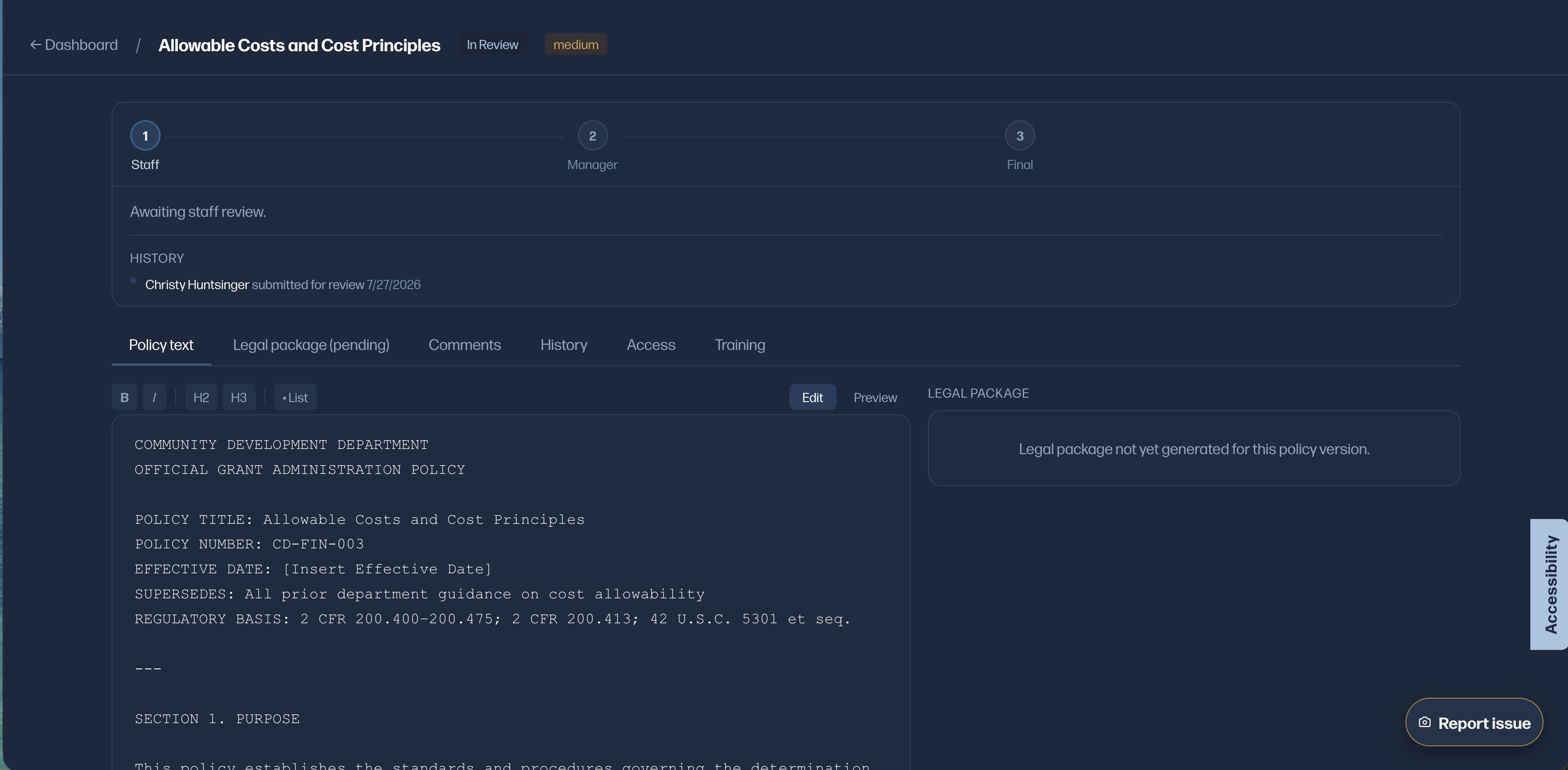
Tracked changes, anchored comments, and the approval chain a policy has to clear before it is finalized.
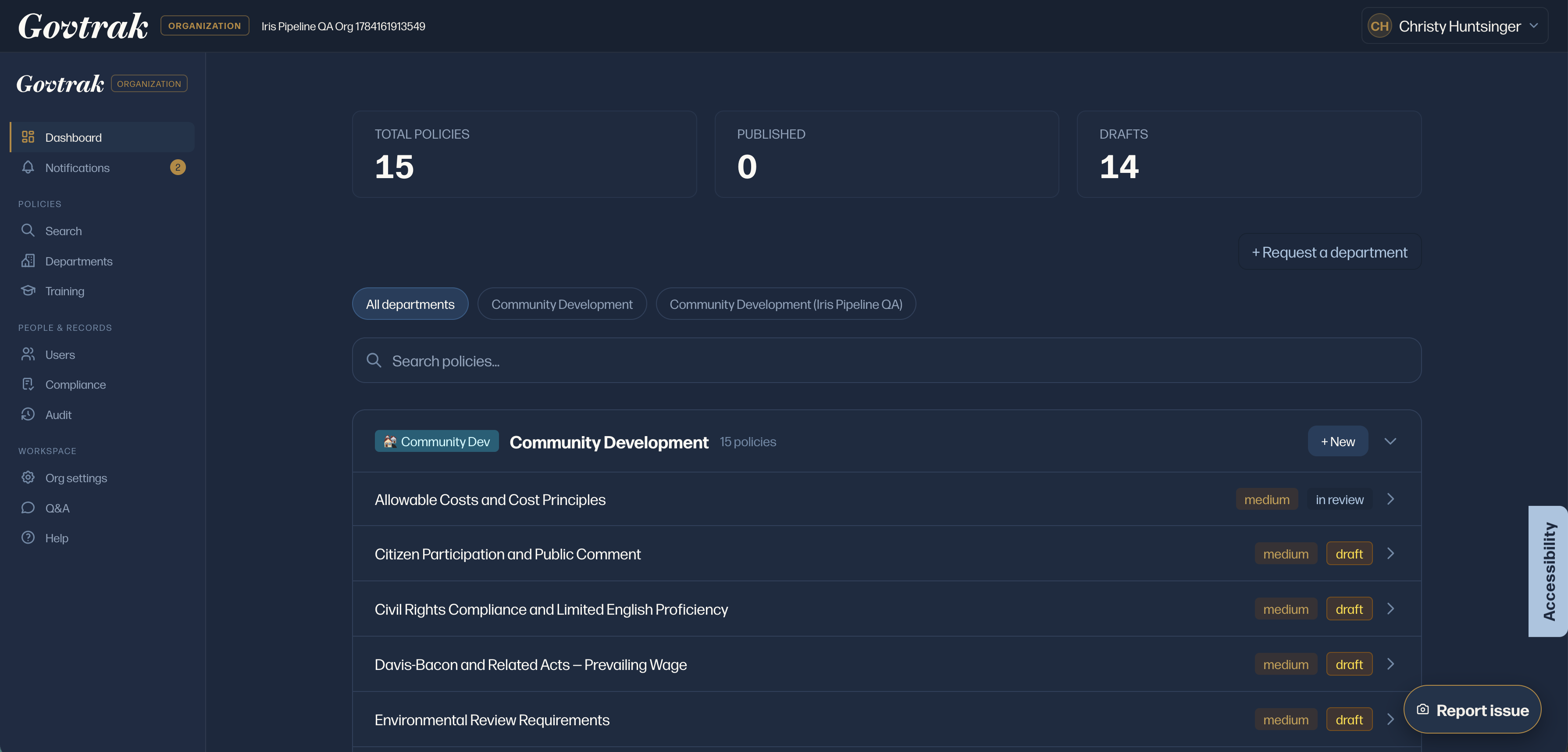
Acknowledgment by version and department, exportable the moment a monitor asks who had read what.
How it works
HUD policies from draft to finalized
Nothing is finalized until your agency approves it.
01
Set up your agency
Onboarding captures who does what: who reviews, who approves, who can edit, and who only needs to read. That roster is what the approval chain routes against, and an admin can change it at any time.
02
Your library lands as drafts
Policies are generated for your programs and your state, and your existing documents come in alongside them. Everything arrives as a draft. Nothing is finalized until you finalize it.
03
Review, edit, and route
Edit in place with every change tracked, comment where you want a second opinion, then send it up the chain. Staff, then Manager, then Assistant Director, with the ability at any step to send it back with instructions.
04
Finalize and acknowledge
The final approver finalizes it, which creates a version and sets the effective date. Personnel acknowledge that version, and the record shows who has and who has not.
05
Stay current
When HUD changes a rule, the affected policies are flagged with a suggested edit. It arrives as a draft and runs the same chain. Scheduled review cycles come due on the interval you set.
Coverage
Every policy a HUD monitor will ask about
The library covers all four entitlement programs plus the federal cross-cutting requirements that apply to every one of them.
CDBG, HOME, ESG, HOPWA
Program-specific policies for each entitlement grant — eligible activities, income eligibility, timeliness, match requirements, and more, drafted for your program.
Federal cross-cutting requirements
Environmental review, Davis-Bacon prevailing wage, Section 3, fair housing/AFFH, procurement and conflict of interest, financial management, single audit, and records retention.
Kept current
AI-assisted citation refresh flags policies that reference superseded regulations, so your library doesn’t quietly go stale between audits.
Audit-ready by design
Every policy is built to produce the acknowledgment and version records a HUD monitor asks to see — not retrofitted after the fact.
Who it's for
Built for HUD grantees. Law enforcement and fire coming soon.
The policy library and regulatory packages are built around CDBG, HOME, ESG, and HOPWA compliance requirements today. Law enforcement and fire policy libraries are in development as a separate future module.
Available now
HUD / Community Development
Entitlement grantees running CDBG, HOME, ESG, and HOPWA.
Coming soon
Law enforcement
A separate policy library in development for police departments.
Coming soon
Fire departments
Fire and EMS policy coverage planned as a future module.
Pricing
One price, invoiced directly
One annual license covers every policy, every user, and every update for the year. Your policies, versions, and acknowledgment records export in full at any time.
Starting at
$8,000 / year
Unlimited users. No implementation fee. No per-module pricing.
Every policy shows its work
Each one carries the regulations and statutes it rests on, linked to the source. When someone asks why a policy says what it says, the answer is in the document, not in the memory of whoever wrote it.
The record assembles itself
Approvals, versions, tracked changes, and acknowledgments are captured as your staff works. When a monitor asks what was in effect in March and who had read it, that is a lookup, not a week of reconstruction.
No implementation project
Your existing library is migrated and your staff is trained as part of the license. There is no separate statement of work and no consultant engagement to schedule.
What's included
The library
Getting to finalized
The record
Your agency
Stay informed
Get notified when we launch
We're onboarding pilot HUD grantees now. Law enforcement and fire modules are in development. Leave your agency email and we'll reach out.